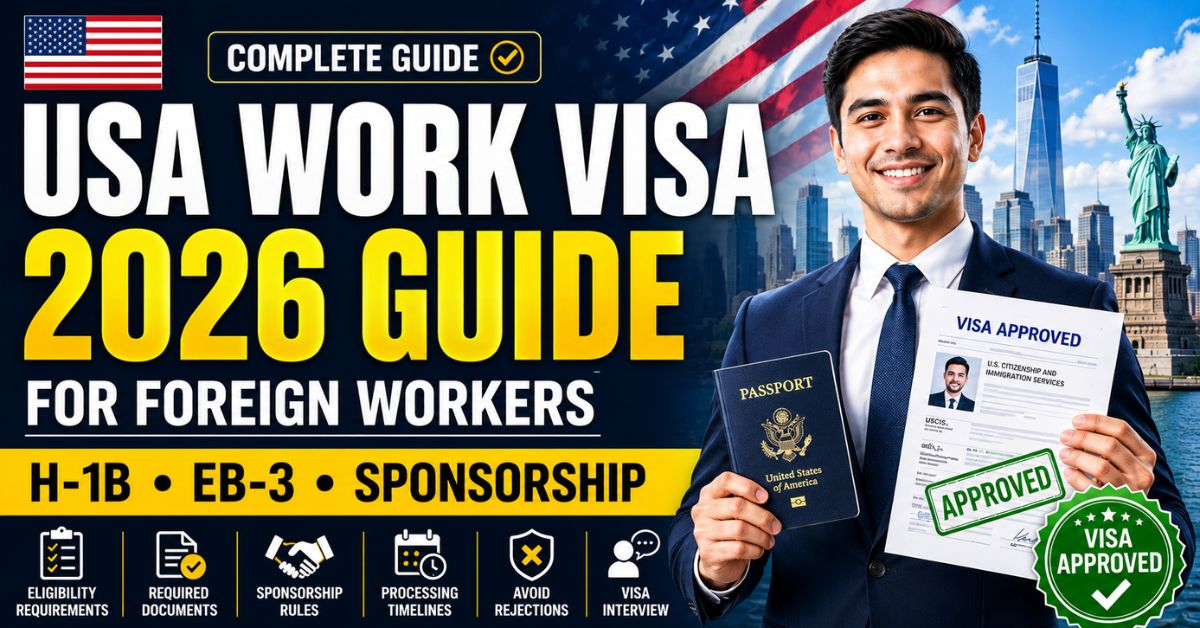
Work Visa in the United States of America as a foreign worker is mostly possible, but only if the worker follows the proper rules before starting to get the visa. From different countries, different skilled professionals, including the Philippines, Nigeria, India, and Sri Lanka, etc. According to the feedback of the professionals, most of them are rejected for some common mistakes that they missed to prevent.
If anyone is interested to get the work visa in the USA, then following the right steps can increase the chances. This post is designed to help with the process and shortcut the confusion.
If you are a software engineer looking for an H-1B, a corporate manager pursuing an L-1, or a skilled tradesperson trying to target the EB-3 green card. For all types of work visas the eligibility, required documents, sponsorship obligations, visa interview, exact reasons fr the failure of the application, and processing timelines are discussed below.
What Is an Employer-Sponsored USA Work Visa?
Employer work visa means that the concerned company holds the responsibility of taking the worker to the United States for work purposes. This visa is different than the student or tourist visa. Unlike a student and tourist visa, the worker cannot apply on their own; it is initiated by the employer, and the employer files the petition with the government on behalf of the worker.
Another important point is that the U.S. Department of Labor and U.S. Citizenship and Immigration Services oversee this system to ensure that the qualified workers of America are not displaced by foreign workers; on the other hand, that the employers meet working condition standards and wages.
H-1B Visa Requirements 2026: Specialty Occupations
The most common work visa for workers is the H-1B, which is best known for the temporary work visa for skilled workers. To qualify for the H-1B work visa, the requirements should be met.
Eligibility Requirements For H-1B Visa
| Requirement | Simple Explanation |
|---|---|
| Education | Bachelor’s degree or equivalent qualification. Some jobs may accept 12 years of work experience instead. |
| Job Offer | You must have a job offer for a skilled position that usually requires a degree. |
| Common Fields | IT, Engineering, Finance, Accounting, Architecture, Medicine, etc. |
| Employer | A genuine U.S. employer must sponsor you and pay the required salary. |
| Visa Cap | 65,000 H-1B visas are available each year, plus 20,000 extra for U.S. master’s graduates. |
| Lottery System | Because there are more applicants than visas, USCIS selects applicants through a lottery. |
Sponsorship Rules For H-1B Visa
H-1B holds some sponsorship rules, such as the employer of the worker is to file a Labor Condition Application (LCA) with DOL while submitting the petition. Then the Labor Condition Application confirms:
- The offered wage meets or exceeds the prevailing wage for that role in that location
- Working conditions won’t adversely affect other employees
- No labor disputes exist at the worksite
Workers cannot do self petition for H-1B visa, employer files Form I-129 with USCIS.
Also Read: H-1B Visa 2026 Update: New Rules, Fee Increase, Changes & Extension Processing Time
Documents Required for USA Work Visa (H-1B)
| Document | Simple Explanation |
|---|---|
| Job Offer Letter | Signed letter showing your job title, salary, and start date. |
| Educational Documents | Degree certificates, transcripts, and foreign degree evaluations (if required). |
| Resume/CV | Document showing your skills, education, and work experience. |
| LCA | Certified Labor Condition Application approved for the employer. |
| Employer Documents | Business registration and financial records proving the company is legitimate. |
| Form I-129 | H-1B petition form submitted by the employer to USCIS. |
| Passport | Valid passport with at least 6 months of validity beyond your stay. |
| DS-160 Form | Online U.S. visa application form. |
| Interview Confirmation | Appointment confirmation for your U.S. visa interview. |
| Fee Receipt | Proof of payment for any required visa or SEVIS fees (if applicable). |
L-1A / L-1B Visa: Intracompany Transferee Requirements
L-1A is also known as L-1B, which is ideal for employees who are connected with multinational companies that are being transferred to a U.S. office, affiliate, or subsidiary.
Eligibility Requirements For L-1A / L-1B Visa
| Requirement | Simple Explanation |
|---|---|
| Employment History | You must have worked for the company (or a related company) outside the U.S. for at least 1 continuous year during the last 3 years. |
| L-1A Visa | For managers and executives being transferred to a U.S. office. |
| L-1B Visa | For employees with specialized knowledge of the company’s products, services, processes, or technology. |
| Education | No minimum degree is required, but you must qualify under the L-1A or L-1B category. |
O-1 Visa: Extraordinary Ability Requirements
Designed for individuals who have risen to the very top of their field.
Eligibility Requirements For 0-1 Visa
| Requirement | Simple Explanation |
|---|---|
| Extraordinary Ability | You must show exceptional talent and achievements recognized nationally or internationally. |
| Eligible Fields | Sciences, Arts, Education, Business, or Athletics. |
| Supporting Evidence | Major awards, published work, high salary, important role in a respected organization, or significant media coverage. |
The O-1 does not require a specific educational degree but demands extensive documentation of achievement.
Also Read: How to Get a Temporary Work Visa in Canada in 2026: The Complete Guide
EB-2 and EB-3 Green Card Requirements: Permanent Work Visas
If a worker is seeking permanent residency in the U.S. as a foreign skilled worker through employment. The permanent U.S. residency has the EB-2 primarily, and EB-3 categorized pathways.
EB-2 (Second Preference)
- Who qualifies: Professionals with advanced degrees (master’s or higher, or bachelor’s plus 5 years progressive experience), or individuals with exceptional ability in sciences, arts, or business
- NIW option: If your work is in the national interest of the U.S., you may self-petition under the National Interest Waiver (NIW) without employer sponsorship
EB-3 (Third Preference)
- Skilled workers: Minimum 2 years of training or experience, with a permanent job offer
- Professionals: U.S. baccalaureate degree or foreign equivalent
- Unskilled workers: Jobs requiring less than 2 years training — important for workers from Bangladesh, Nepal, the Philippines, Sri Lanka, and Nigeria entering sectors like hospitality, construction, and food processing
PERM Labor Certification: The Critical First Step
Most EB-2 and EB-3 petitions require PERM (Program Electronic Review Management) certification from the DOL. Your employer must:
- Conduct a genuine recruitment effort to test the U.S. labor market
- Document that no qualified, willing U.S. worker is available for the position
- Offer at least the prevailing wage
- File Form ETA-9089 electronically
PERM processing currently takes 6–18 months. Only after approval can the employer file Form I-140 (Immigrant Petition for Alien Workers) with USCIS.
Also Read: How to Write a Dishwasher Resume That Gets You Hired
USA Work Visa Interview Requirements
After USCIS approves the petition, you must attend a visa interview at a U.S. embassy or consulate in your home country.
What to Bring to Your Visa Interview
- Valid passport (and any expired passports)
- DS-160 confirmation page
- Visa application fee payment receipt
- Photo meeting U.S. visa photo requirements
- Approved petition notice (Form I-797 for H-1B, L-1; NVC package for EB categories)
- All supporting documents used in the original petition
- Evidence of ties to your home country (for nonimmigrant visas)
- Financial documents showing no intent to become a public charge
Processing Times in 2026
| Visa Type | Standard Processing | Premium Processing |
|---|---|---|
| H-1B (I-129) | 3–6 months | 15 business days |
| L-1 (I-129) | 3–5 months | 15 business days |
| O-1 (I-129) | 3–4 months | 15 business days |
| EB-3 PERM | 6–18 months | Not available |
| EB-3 I-140 | 6–12 months | 15 business days |
Common Reasons USA Work Visa Applications Are Rejected
Most of the professional workers’ work visa applications are rejected due to unknowing of what to submit. Some of the reasons that lead to the rejection of the Visa Application are as follows:
- Specialty occupation not established (H-1B)
- LCA wage violations
- Insufficient qualifying experience
- Employer ability to pay not demonstrated
- PERM recruitment not genuine
- Fraud or misrepresentation
- Overstay history or prior visa violations
- Weak ties to home country (nonimmigrant visas)
Actionable Tips for a Successful Application
If the worker is really intended to submit a work visa application, start early; typically, the H-1B registration opens in March. For EB-3, PERM can take over a year. So to avoid missing the plan starting 18 to 24 months ahead.
Choosing the right employer is another useful step. The financial stability, historical compliance, and experience with immigration filing matters most for successful work visa applications.
For a successful work visa application, use a qualified immigration attorney, and also check the Visa Bulletin for EB-2 & EB-3. The country of birth determines the priority.
Using the official U.S. Visa Wizard to identify which categories of visas fit the profession before beginning any further process. The Official U.S. Wizard is accessible through the web address: travel.state.gov
Frequently Asked Questions
Can I get a USA work visa without a job offer?
Only O-1 and EB-2 NIW can sometimes be applied without a job offer. Most U.S. work visas need a confirmed job offer from a U.S. employer.
What is the minimum salary for an H-1B visa in 2026?
There is no fixed minimum salary; employers must pay the required prevailing wage based on the job and location.
Is the H-1B lottery mandatory?
Yes, most applicants must go through the H-1B lottery, unless the employer is cap-exempt (such as a university or research organization).
Also Read: Saudi Caregiver Jobs Visa 2026 – Full Apply Guide for Foreigners
Final Thoughts
In the U.S., sponsored employer work is in high demand, and it is designed to protect foreign nationals as well as American workers from an unfair situation. For the skilled professionals who fulfill the requirements and are eligible, have well defined path to work in a legitimate way with a committed employer.
A worker should know the visa category, as discussed in the post above. Different types of visas are discussed, each one is used for a different purpose. After knowing the visa type, assemble the required documents. Remember each visa category has specific type of documents in demand.
Prepare all essential things in advance and research every step clearly to avoid last time hustle. Normally, immigration takes time to process. It is better to be ready and on time.
Disclaimer: All of the information discussed above is for educational and informational purposes. Rules and processes often encounter changes in the immigration process. When applying, always confirm and stay up to date with official platforms.

Discover more from AlertsU.Com
Subscribe to get the latest posts sent to your email.
1 thought on “USA Work Visa Requirements 2026: The Complete Guide for Foreign Skilled Workers”